
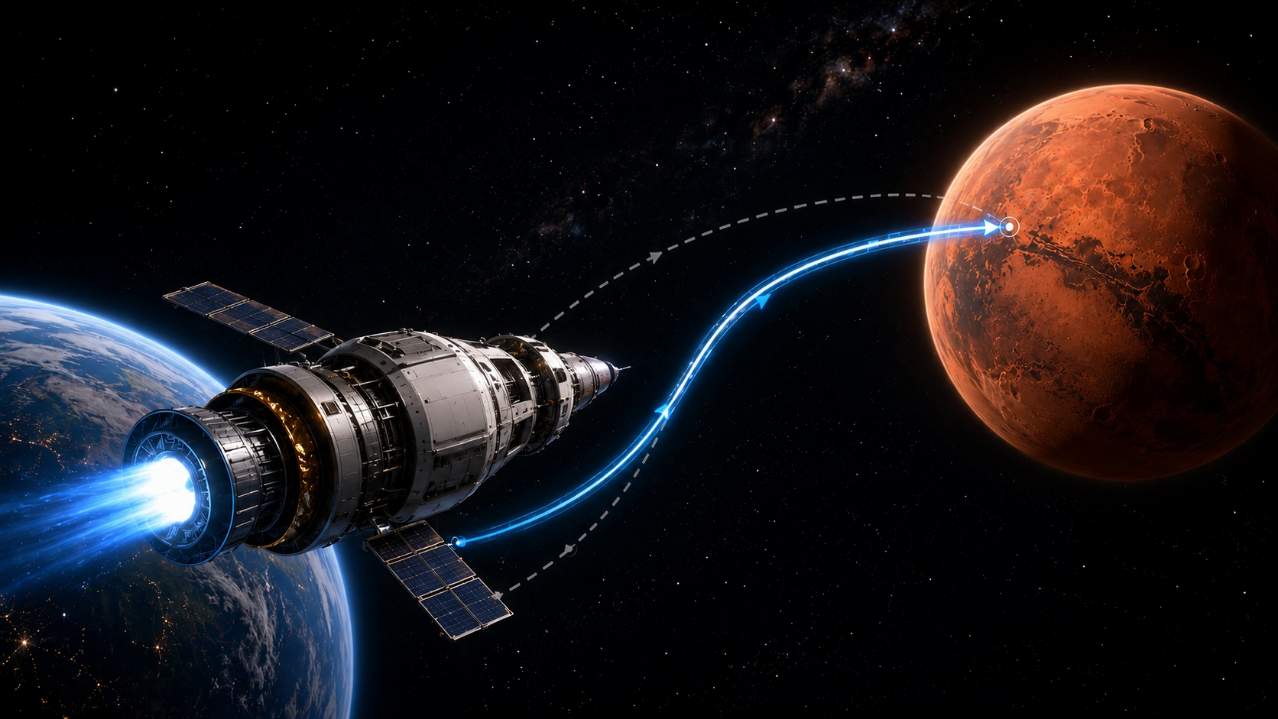
Traditional Mars missions require immense patience. Based on the standard minimum-energy Hohmann transfer orbit, a one-way trip to the Red Planet typically demands seven to ten months traversing the void of deep space, followed by a lengthy stay on the surface waiting for planetary realignment. But a Brazilian physicist’s recent accidental discovery—hidden within the mathematical errors of old astronomical data—might just rewrite our interplanetary itineraries.
The Ghost Trajectory of 2001 CA21
The story begins not with a newly designed rocket, but with a computational discrepancy regarding a near-Earth object. In 2015, Marcelo de Oliveira Souza, a physicist and professor at the State University of Northern Fluminense in Brazil, was analyzing early orbital predictions of the asteroid 2001 CA21. Preliminary data for newly discovered space rocks is often imprecise and is typically discarded once further observations refine the trajectory.
However, Souza noticed something striking about this initial, flawed data. The asteroid’s preliminary orbit traced a highly unusual sub-ecliptic plane that essentially sliced straight through the orbital paths of both Earth and Mars. This ghost trajectory created a theoretical geometric corridor perfectly suited for rapid interplanetary transit.
This was a surprise for me, and I was not looking for this, Souza admitted in an interview with Live Science. Acknowledging the serendipitous nature of finding value in discarded data, he added that maybe he was in the right place at the right time.
The 2031 Express Window
Souza spent years refining his calculations, eventually applying a technique known as Lambert analysis to map the shortest arcs between the two planets while anchoring the flight path to the asteroid’s initial five-degree tilt. The results, recently published in the prestigious journal Acta Astronautica, present a paradigm shift in mission planning.
By utilizing this geometric shortcut, a spacecraft would no longer have to coast along a low-energy transfer orbit. During specific planetary alignments, known as oppositions, the travel time plummets. Souza’s modeling identified the 2031 Mars opposition as an exceptionally rare window where this rapid architecture becomes geometrically possible.
The numbers outline a radically different timeline for human exploration. In the extreme scenario, the math supports an astonishing 153-day round trip. This profile involves a 33-day outbound sprint to Mars, a 30-day stay on the surface, and a 90-day return journey. A slightly more feasible alternative offers a 226-day round trip, featuring a 56-day outbound leg.
The Physics vs. The Payload
While the orbital mechanics elegantly map out a new way to bridge the gap between worlds, turning this theoretical pathway into a practical crewed mission presents staggering engineering hurdles. Escaping Earth’s gravity and accelerating into this fast-track corridor requires an immense amount of launch energy—far exceeding the capabilities of our current heavy-lift rockets, especially when carrying the massive payloads required for human survival.
Furthermore, arriving at Mars in mere weeks means the spacecraft would be traveling at blistering speeds, potentially up to 20 kilometers per second. Braking into Martian orbit or plunging directly into its atmosphere at such velocities demands thermal shielding and propulsive deceleration technologies that simply do not exist yet.
Souza himself is acutely aware of the gap between mathematical theory and current aerospace engineering capabilities. Speaking to CNN Brasil, he emphasized his role in the broader puzzle, noting that to carry out a trip, it is necessary to adjust the rocket’s speed to see if it reaches his proposal, and there is the question of what payload can be carried. He stated clearly that his role was to make the theoretical proposal.
A New Map for the Solar System
Despite the immense technological barriers, Souza’s research proves that the solar system may hold hidden geometric highways we have yet to fully understand. By looking back at the discarded, noisy data of an asteroid’s first calculations, a professor working far from the hubs of major international space agencies has provided the world with a brilliant new template for interplanetary navigation.
As Souza proudly noted, he does not work at a space agency, but as a professor at his university, he achieved a new result that allows for a faster trip to Mars using the trajectory of an asteroid as a basis.
His discovery ensures that as our propulsion and shielding technologies finally catch up to the math, we already have a map for the fast lane.
Journal Refrence: De Oliveira Souza, M. (2026). Using asteroid early orbital data for rapid mars missions. Acta Astronautica, 246, 354–366. DOI: 10.1016/j.actaastro.2026.04.018
