
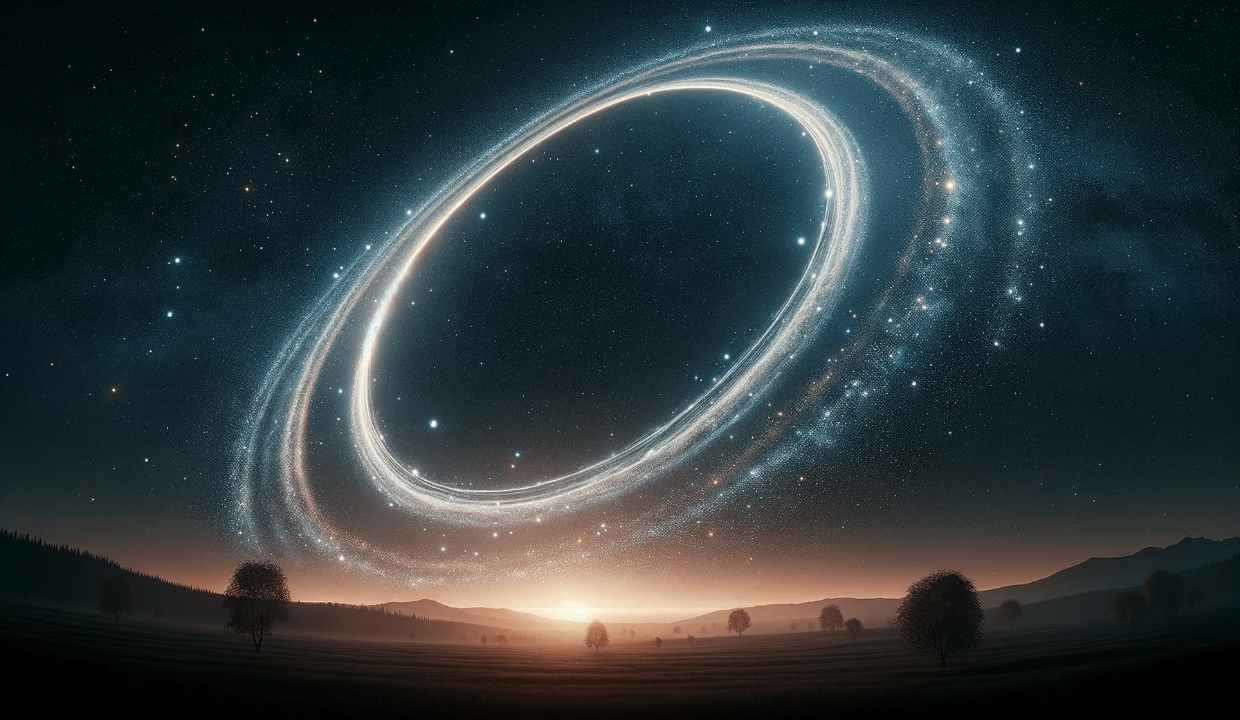
The discovery of a second ultra-large structure in the remote universe has further challenged some of the basic assumptions about cosmology.
The Big Ring in the Sky is 9.2 billion light-years from Earth. It has a diameter of about 1.3 billion light-years, and a circumference of about 4 billion light-years. If we could step outside and see it directly, the diameter of the Big Ring would need about 15 full moons to cover it.
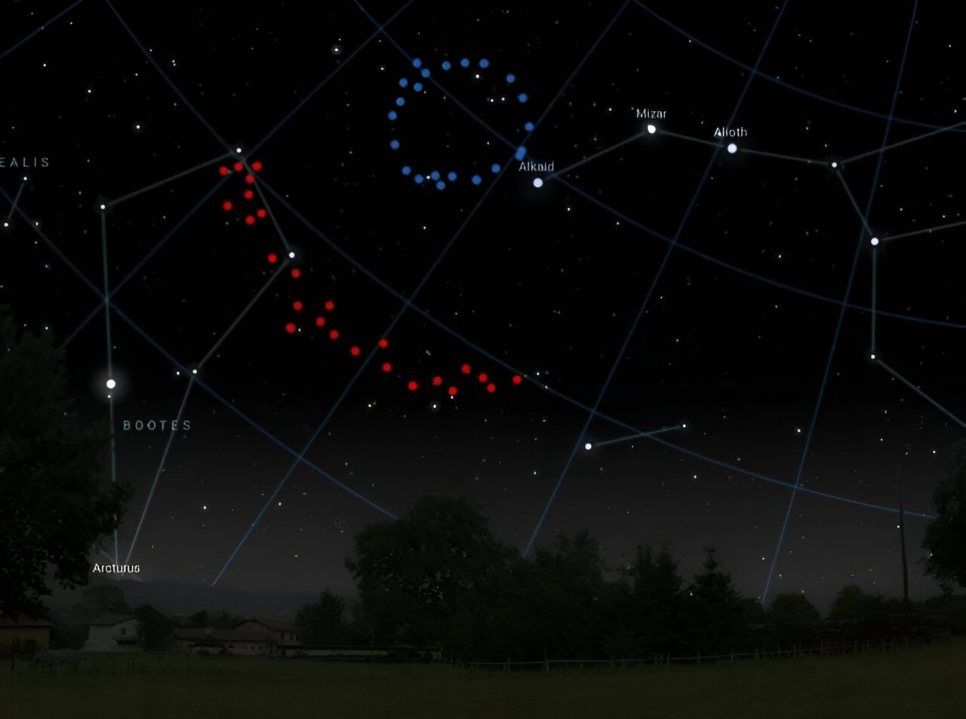
It is the second ultra-large structure discovered by University of Central Lancashire (UCLan) Ph.D. student Alexia Lopez who, two years ago, also discovered the Giant Arc in the Sky. Remarkably, the Big Ring and the Giant Arc, which is 3.3 billion light-years across, are in the same cosmological neighborhood—they are seen at the same distance, at the same cosmic time, and are only 12 degrees apart in the sky.
Alexia said, “Neither of these two ultra-large structures is easy to explain in our current understanding of the universe. And their ultra-large sizes, distinctive shapes, and cosmological proximity must surely be telling us something important—but what exactly?
“One possibility is that the Big Ring could be related to Baryonic Acoustic Oscillations (BAOs). BAOs arise from oscillations in the early universe and today should appear, statistically at least, as spherical shells in the arrangement of galaxies. However, detailed analysis of the Big Ring revealed it is not really compatible with the BAO explanation: The Big Ring is too large and is not spherical.”
Other explanations might be needed, explanations that depart from what is generally considered to be the standard understanding in cosmology. One possibility might be a different theory—Conformal Cyclic Cosmology (CCC)—which was proposed by Nobel-prize winner Sir Roger Penrose. Rings in the universe could conceivably be a signal of CCC.
Another explanation might be the effect of cosmic strings passing through. Cosmic strings are filamentary “topological defects” of great size, which could have been created in the early universe. Another Nobel-prize winner, Jim Peebles, recently hypothesized that cosmic strings could have a role in the origin of some other peculiarities in the large-scale distribution of galaxies.
Furthermore, the Big Ring challenges the Cosmological Principle, as did the Giant Arc previously. And if the Big Ring and the Giant Arc together form a still larger structure then the challenge to the Cosmological Principle becomes even more compelling.
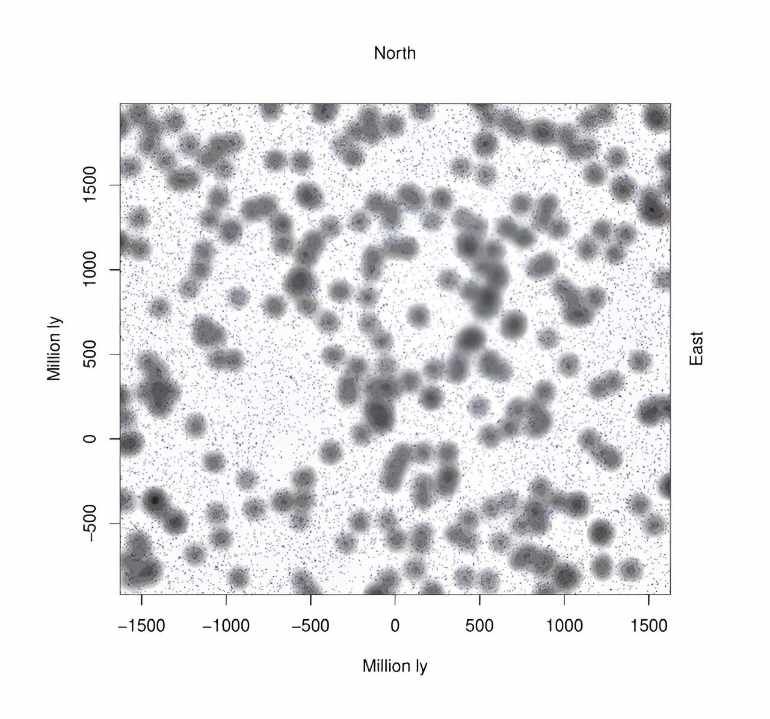
Such large structures—and there are others found by other cosmologists—challenge our idea of what an “average” region of space looks like. They exceed the size limit of what is considered theoretically viable, and they pose potential challenges to the Cosmological Principle.
Alexia said, “The Cosmological Principle assumes that the part of the universe we can see is viewed as a ‘fair sample’ of what we expect the rest of the universe to be like. We expect matter to be evenly distributed everywhere in space when we view the universe on a large scale, so there should be no noticeable irregularities above a certain size.
“Cosmologists calculate the current theoretical size limit of structures to be 1.2 billion light-years, yet both of these structures are much larger—the Giant Arc is almost three times bigger and the Big Ring’s circumference is comparable to the Giant Arc’s length.
“From current cosmological theories we didn’t think structures on this scale were possible. We could expect maybe one exceedingly large structure in all our observable universe. Yet, the Big Ring and the Giant Arc are two huge structures and are even cosmological neighbors, which is extraordinarily fascinating.”
The Big Ring appears as an almost perfect ring in the sky, but Alexia’s further analysis reveals that it has more of a coil shape, like a cork-screw, that is aligned face-on with Earth. The Giant Arc, which is approximately 1/15th the radius of the observable universe, shows as an enormous, nearly symmetrical, crescent of galaxies in the remote universe. It is twice the size of the striking Sloan Great Wall of galaxies and clusters that is seen in the relatively nearby universe.
“The Big Ring and Giant Arc are the same distance from us, near the constellation of Boötes the Herdsman, meaning they existed at the same cosmic time when the universe was only half of its present age” commented Alexia. “They are also in the same region of sky, at only 12 degrees apart when observing the night sky.
“Identifying two extraordinary ultra-large structures in such close configuration raises the possibility that together they form an even more extraordinary cosmological system.
“This data we’re looking at is so far away that it has taken half the universe’s life to get to us, so from a time when the universe was about 1.8 times smaller than it is now. The Big Ring and the Giant Arc, both individually and together, gives us a big cosmological mystery as we work to understand the universe and its development.”
Alexia, together with adviser Dr. Roger Clowes, both from UCLan’s Jeremiah Horrocks Institute, and collaborator Gerard Williger from the University of Louisville, U.S., discovered the new structure by looking at absorption lines in the spectra of quasars from the Sloan Digital Sky Survey (SDSS).
Using the same method that led to the discovery of the Giant Arc, they observed the intervening Magnesium-II (or MgII—it means the atom has lost an electron) absorption systems back-lit by quasars, which are remote super-luminous galaxies. These very distant, very bright, quasars act like giant lamps shining a spotlight through distant, but much fainter, intervening galaxies that otherwise would go unseen.
Alexia has presented her findings on the Big Ring at the 243rd meeting of the American Astronomical Society (AAS) on 10 January.

The Great Ring in the Helium Cluster Model (HCM)
A possible interpretation of the spiral structure as a cross‑section through a bubble wall
The observation of The Great Ring — a 1.3‑billion‑light‑year spiral structure seen face‑on — can be understood within the Helium Cluster Model as a cross‑section through the bubble‑web of the Star Ocean at a time when its diameter was significantly larger than today. In HCM, the Star Ocean consists of a foam of helium bubbles, where galaxies do not reside inside the bubbles but between them, at the contact points where several bubbles meet.
A spiral, not a perfect ring
Analysis of the observation shows that The Great Ring is not a perfect circle, but a coil‑shaped structure, a three‑dimensional spiral that happens to be oriented face‑on toward our line of sight. The ring‑like appearance is therefore a projection effect: we are looking straight down the axis of the spiral.
In HCM, this is exactly what one would expect when viewing a bubble wall — the curved interface between two helium bubbles — in cross‑section. Bubble walls are not flat; they are spherically curved and may be twisted relative to one another. When such a wall is sliced in a thin sector and projected toward us, it can appear as a closed ring, an arc, or — if the wall is twisted — a spiral.
Sacks ejecting material in a spiral pattern
Every bubble wall in HCM contains sacks that empty when bubbles interact. These sacks can eject gas and dust in spiral patterns along the surface of the wall. Since The Great Ring was discovered through Mg II absorption in the light of background quasars — that is, through gas and dust rather than starlight — it is natural to interpret the structure as an active contact zone between two bubbles, where sacks along the wall have released material in a spiral geometry.
The scales match
At the epoch when the light from The Great Ring was emitted, the universe was roughly half its current size. In HCM, this corresponds to a time when the Star Ocean had a diameter of about 100 Gly. A spiral structure of 1.3 Gly is therefore a natural size for:
a local cross‑section through a bubble wall near the top of the sphere, or
a contact region between two bubbles in a dense part of the web.
Thus, the observation does not show the entire cluster, but a single wall or contact surface, projected as a spiral.
An HCM interpretation of The Great Ring
Within the Helium Cluster Model, The Great Ring can be described as follows:
“The Great Ring is a spiral‑shaped contact surface between two helium bubbles in the Star Ocean, seen face‑on. The spiral form arises when sacks along the wall eject gas and dust in a twisted geometry. The ring‑like projection is a cross‑section through a curved wall in a much larger bubble cluster, at a time when the Star Ocean was significantly larger than it is today.”